
Vascular experts warn that prolonged screen time, gaming, and binge-watching are creating a new generation of young people spending hours without moving their legs; latest research finds 24% higher VTE risk with high sedentary behaviour
Shailender Kr Pandey
New Delhi, 9 October
India’s growing screen-time culture may be creating a new vascular-health challenge among young people, with vascular specialists warning that prolonged sitting during online gaming, binge-watching on OTT platforms, online education, and extended computer use can reduce leg movement and venous blood flow and contribute to conditions such as deep vein thrombosis (DVT). The warning was issued at the VSI-ASVS 2026 conference, held from October 8 to 10 in New Delhi, which brought together more than 400 faculty members and over 1,000 delegates from India and abroad to discuss advances and emerging challenges in vascular and endovascular surgery.
Deep vein thrombosis is a condition where a blood clot forms in the deep veins, usually in the legs, and can block normal blood flow. If left untreated, the clot can travel to the lungs and cause a serious, potentially life-threatening blockage. Once considered a condition linked to older age or hospitalisation, DVT is now being seen in otherwise healthy individuals, and experts say the shift is driven by how we live, work, and relax.
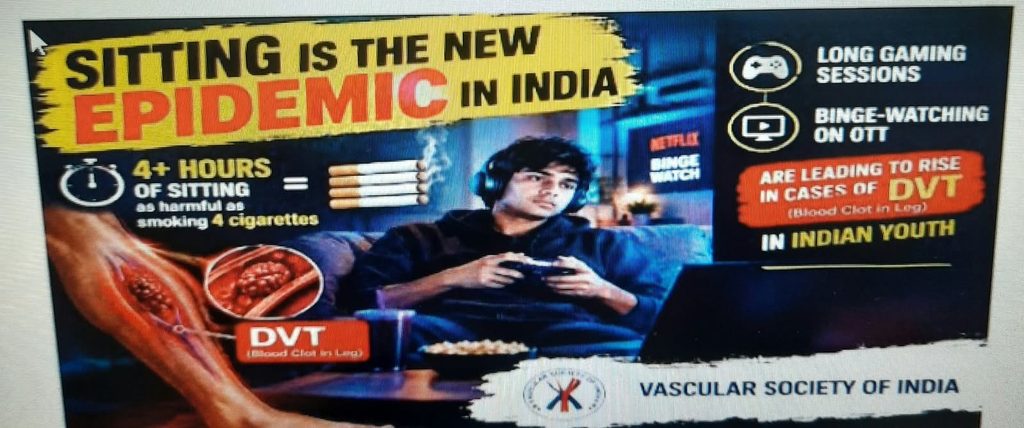
Doctors at the conference said that the problem is increasingly relevant to India’s younger population, where entertainment, education, gaming, and social interaction are increasingly screen-based. Unlike traditional risk factors that are often associated with older adults, prolonged digital-device use can expose otherwise young and apparently healthy individuals to long periods of physical inactivity. Experts stressed that gaming or watching OTT content does not automatically cause DVT, but hours of uninterrupted sitting can become an important additional risk factor, particularly when combined with obesity, dehydration, smoking, hormonal factors, inherited clotting disorders, or a previous history of thrombosis.
A major 2024 systematic review and dose-response meta-analysis published in Scientific Reports, which included 25 articles and 31 studies, found that people with the highest levels of sedentary behaviour had approximately a 24% higher risk of venous thromboembolism (VTE) compared with those with the lowest levels. More importantly, the researchers found a 2% increase in VTE risk for every additional hour of sedentary behaviour per day. The association remained even after adjustment for physical activity, suggesting that simply exercising at one point in the day may not completely offset the potential risks associated with spending long periods sitting.
Dr Tapish Sahu, Organising Secretary, VSI-ASVS 2026, and director & head of the department of Vascular & Endovascular Surgery at Max Hospital, New Delhi, said, “We are increasingly seeing young patients in our OPD with symptoms that make us look closely at their lifestyle, including prolonged sitting, excessive screen exposure, and long gaming sessions. The latest evidence is concerning because the risk is not restricted to completely inactive people. The 2024 meta-analysis found about a 24% higher risk of VTE among those with the highest sedentary exposure, while every additional hour of sedentary behaviour was associated with approximately a 2% increase in VTE risk. When a young person sits continuously for four, five or six hours playing games or binge-watching OTT content, the calf muscles are barely working as a pump for venous blood. We need to make movement breaks a part of digital life.”
The emerging concern has also been highlighted by research specifically examining adolescents and prolonged digital exposure. A recent study of adolescents with thrombosis identified 11 patients who reported at least four hours of daily screen exposure. Their average digital-device use was approximately six hours per day, while uninterrupted immobility averaged 2.7 hours. Eight of the 11 adolescents had lower-extremity DVT, two had pulmonary embolism and one had subclavian-vein thrombosis. Researchers also identified inherited thrombophilia in many of these patients, underlining an important point: prolonged digital immobility may act as a trigger or additional risk factor, rather than being the sole cause of thrombosis.
Dr. Tarun Grover, Organising Chairman, VSI-ASVS 2026 and Senior Director of Peripheral Vascular and Endovascular Sciences at Medanta, said, “In our OPD, we are seeing patients where lifestyle history has become an important part of the vascular evaluation. Earlier, when we thought about prolonged immobility, we primarily discussed long-distance travel, hospitalisation or being bedridden. Today, we also need to ask young patients how many hours they spend continuously sitting in front of a gaming console, computer or OTT screen. The evidence showing a 24% higher VTE risk with higher sedentary exposure should make us take this issue seriously. A young age should not create a false sense of security, particularly when prolonged sitting is combined with other risk factors.”
Doctors emphasised that the concern is not that sitting is literally equivalent to smoking, but that both can contribute to vascular risk through different mechanisms. Smoking is a recognised risk factor that can adversely affect blood vessels and promote conditions associated with thrombosis, while prolonged sitting can cause venous stasis—slowing the return of blood from the legs and increasing the risk of clot formation.
Dr. Bhupesh Garg, Senior Vascular & Endovascular Surgeon, Vascular Society of India, said, “Just as smoking increases vascular and clotting risks, prolonged sitting can also increase the risk of blood clots, although through a different mechanism. When a person remains seated for hours, the calf-muscle pump becomes inactive, venous blood flow from the legs slows down, and blood can stagnate in the deep veins. This is particularly concerning when young people spend several uninterrupted hours gaming or binge-watching OTT content. We are seeing more young patients in clinical practice in whom prolonged sedentary behaviour is an important part of the lifestyle history. The message should be simple: if you are going to spend hours on a screen, do not spend those hours completely still.”
The vascular community believes the issue deserves greater attention because sedentary behaviour is no longer confined to office workers. Young people may spend several hours sitting for school or college, followed by gaming, social media, streaming or online entertainment, creating a prolonged period of low physical movement across the day.
The experts emphasised that the popular comparison between sitting and smoking should be understood as a public-health warning rather than a literal scientific equivalence. The evidence does, however, show that prolonged sedentary behaviour has measurable associations with vascular disease, including VTE. The 2024 meta-analysis found that physical activity and sedentary time were independently associated with VTE risk, reinforcing the need not only to exercise but also to break up prolonged sitting.
With more than 1,000 delegates and 400-plus faculty expected at VSI-ASVS 2026, the conference is providing a major platform for discussion on contemporary vascular disease, venous disorders, and emerging lifestyle-related vascular challenges.